Get In Touch
Our contact and address information to discuss your specific needs for your projects.


The consumption of certain natural resources used to meet one of humanity's most fundamental needs, energy, not only causes serious environmental problems but is also among the primary causes of climate change.
The consumption of "fossil energy" resources, such as natural gas, oil, and coal—formed over centuries and with limited reserves in nature—triggers global warming by causing significant carbon emissions.
Unlike fossil energy sources, geothermal, solar, wind, and biomass resources, which are continuously renewable within the natural cycle and offer environmentally friendly "clean energy" production opportunities, are among the most critical tools nations possess for environmental and economic sustainability and combating climate change.
In this context, Turkey took its first step toward utilizing geothermal energy, one of the clean and renewable energy sources, approximately 60 years ago.
Geothermal energy research, which began in the 1960s, bore its first fruit in 1968 when the Kızıldere geothermal field, located in the Sarayköy district of Denizli—home to Turkey's most productive geothermal resources—was discovered. This marked the opening of the first geothermal drilling well intended for electricity generation.

As a result of continued efforts, Turkey's first and Europe's second geothermal power plant began operations in Kızıldere in 1974. Initially established with an installed capacity of only 0.5 MW, this plant has grown through private sector investments to reach an installed capacity of 260 MW today, making it Turkey's largest geothermal power plant.
In the following years, Turkey continued its resource research, leading to the discovery of new geothermal fields. In these efforts, the studies of the General Directorate of Mineral Research and Exploration (MRA) played a critical role.
According to MRA data, Turkey's discovered geothermal resource potential is at 62,000 MW. Considering the undiscovered resources, Turkey, which is currently the leader in Europe and the 4th largest geothermal resource holder in the world, has the potential to become the global leader by a significant margin.
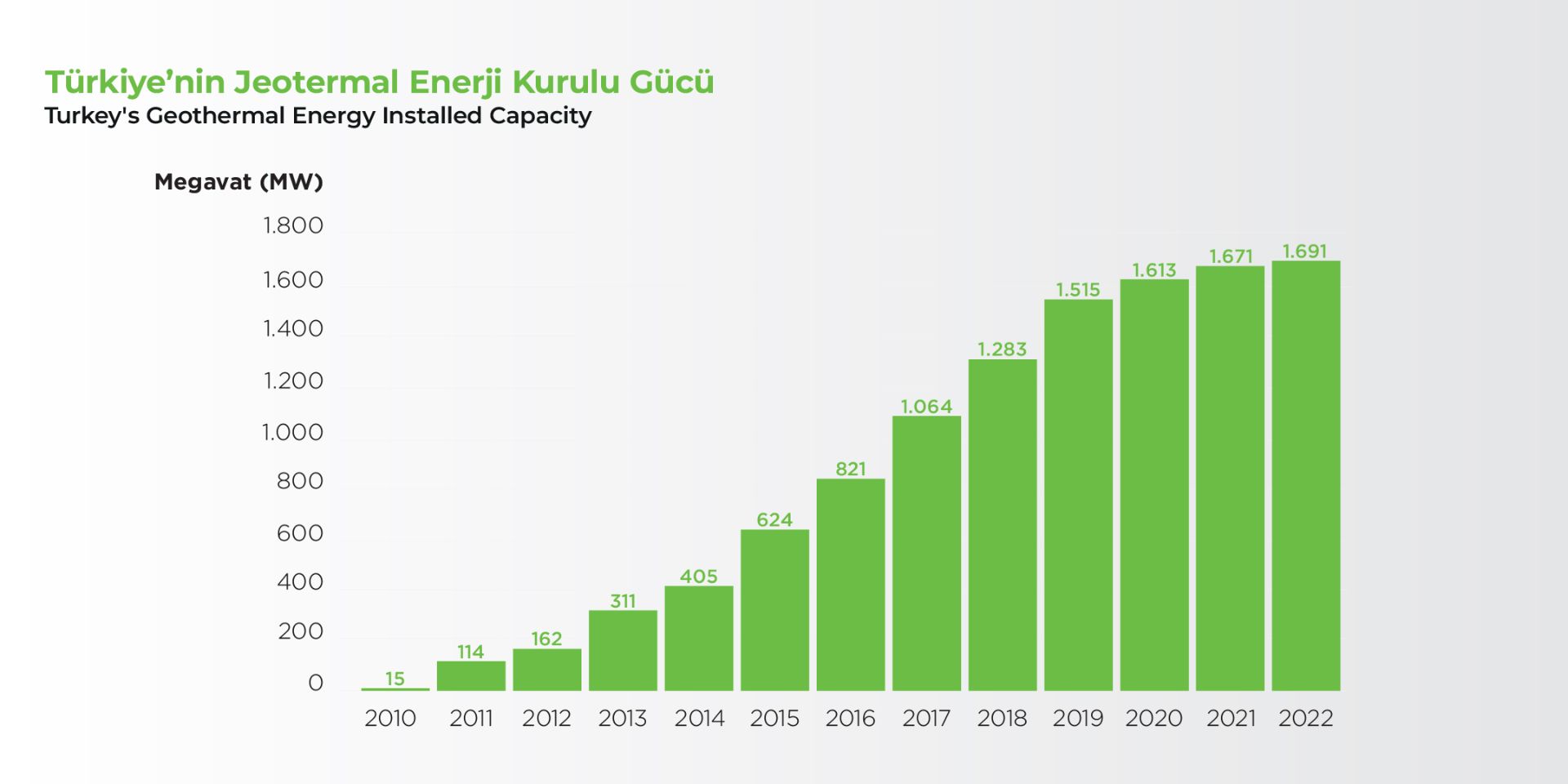
As a result of investments accelerated by the positive impact of the Renewable Energy Sources Support Mechanism, Turkey's geothermal installed capacity increased from 15 MW in 2010 to 1691 MW today, growing by more than 100 times in subsequent years.

With this capacity, Turkey stands out as the 4th largest user of geothermal energy for electricity generation after the United States, Indonesia, and the Philippines.
Turkey aims to increase its geothermal energy capacity from the current 1691 MW to 3000 MW by 2030. To achieve this growth, plans are in place to utilize resources more efficiently and implement new investments.
Nearly the entire installed geothermal energy capacity in Turkey is supplied by geothermal power plants operating in the Aegean Region.
With 887 MW, more than half of the country's total geothermal capacity is located in Aydın, while Denizli has 379 MW, Manisa 378 MW, Çanakkale 30 MW, İzmir 12 MW, and Afyonkarahisar has an installed capacity of 2.76 MW from geothermal energy.